Picture Shop Accelerates Its Dailies Workflow With Tsecond's BRYCK Storage
Tsecond Inc.
Picture Shop, one of Hollywood's top dailies operations, integrated Tsecond's BRYCK Platform to double ingest speeds and enable concurrent processes like color grading and MD5 calculations, cutting turnaround time from 14 hours to under 8.
Today's film and television productions generate massive amounts of data, including video footage, audio recordings, metadata, reference images and 3D scans. Transferring, managing and processing all this media, while keeping pace with the ultra-dynamic creative process, is a daunting technical and operational challenge. And sometimes just thinking about it keeps Dave "TekDave" Graubard up at night. That's because, as global senior systems engineer at Picture Shop, Graubard is responsible for keeping one of Hollywood's top dailies operations running smoothly night after night.
"Five terabytes per show per night is not uncommon anymore," Graubard says of the average amount of raw footage captured by the series and films Picture Shop supports. "Most shows will shoot somewhere between two and three, or even between three and four hours of footage a day. And the volume of data depends upon what camera they're using. So, if it's an ARRI 65 or ARRI 35, it's going to be a bigger load."
Picture Shop's Dave "TekDave" Graubard It's clear to Graubard that with cinema cameras continuing to evolve towards greater resolution and color precision, Picture Shop's dailies teams will need to manage greater volumes of footage every year. Faced with this ever-growing influx of data, Graubard is on a perpetual quest to accelerate Picture Shop's dailies processing workflow to make sure that the productions' editors, producers and directors always find the previous day's footage ready for review early the next morning. "In dailies, we live from night to night," he remarks.
The pressure to deliver consistently is enormous, as turnaround is of paramount concern. "One of the major concerns for filmmakers is that their dailies will be delivered on time," notes David Waters, managing director of Picture Shop in Hollywood.
BRYCK's Core Design and Performance Impact:
Modular Performance
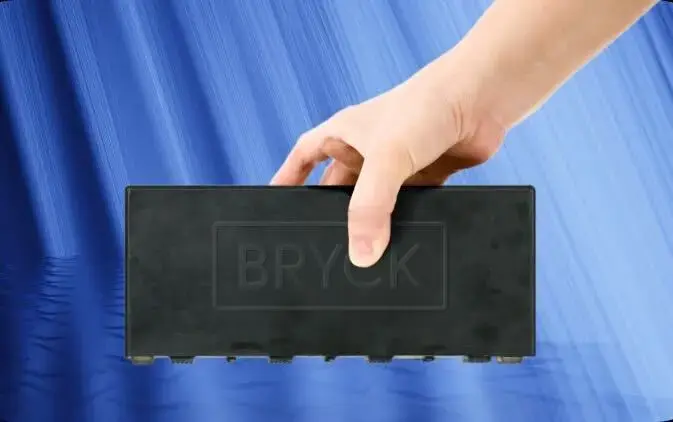
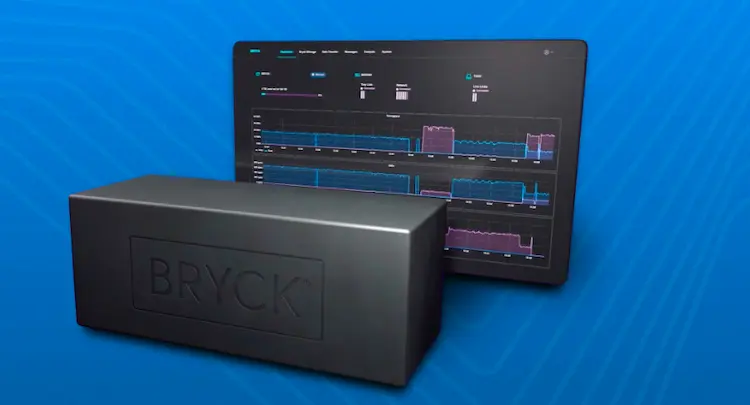
The NVMe-based BRYCK Platform is a secure, portable storage solution that offers up to 1PB of capacity and very high throughput (40 GB/s) in a rugged, compact and tamper-proof form factor. The NVMe drives are contained in a brick-shaped 4"x4"x9.5" enclosure that connects via a tray to a high-performance server through which the workstations can access the storage. This modular design enables rapid and safe physical transit of large volumes of data; the high-capacity portable BRYCK storage can move from tray to tray.
Ingest Speed Improvement
"Looking at it super simply, with 16-gig fibre channel drives, we were pretty much topping out at around 800 to 900 megabytes per second at ingest. With the 25-gig NVMe drives in the BRYCK, we're able to copy at 1500 to1600 megabytes a second. So twice as fast, nearly. It gives us a 50% benefit in just the ingest," says Graubard.
Concurrent Workflows
"What the BRYCK really allows us to do is carry out multiple concurrent processes at once. That's the big benefit. So, yes, we can ingest faster, but as we're ingesting, we can also do MD5 calculations, which then allows us to actually start color grading while we're still ingesting," he explains. "It was something that we were not able to do at the same time (with our previous storage topology) because it would drag down the speed of the drives."
Efficiency and Simplicity
These efficiencies achieved by accelerating processes and performing them in parallel add up — in all, Picture Shop estimates that leveraging BRYCK enables the team to get their night's work done in under eight hours, rather than the usual 12 to 14 hours. BRYCK's ability to sustain many concurrent streams also allows Graubard to simplify Picture Shop's storage topology. "We're doing six shows a night on average on a single 128TB BRYCK and our calculation is that the BRYCK should be able to handle eight shows easily with four operators working concurrently."
When Graubard learned about Tsecond's BRYCK storage platform and its ultra-fast read and write performance, he saw an opportunity to shave hours off the turnaround time for dailies creation and delivery by parallelizing processes that previously had to be performed sequentially. The dailies colorists' Mac, Linux and Windows workstations — running Colorfront's OSD and ExD, as well as Baselight's Daylight — connected to BRYCK over 25 GbE network via StorNex.
Graubard worked with the Tsecond engineering team, which is led by CTO Manalavan Krishnan, to integrate BRYCK within their existing and familiar StorNext environment, rather than utilizing SMB or NFS. "It worked well for us and it allowed us to continue to work in the way that our workflows were designed," notes Graubard.
Picture Shop counts Hollywood's leading studios, producers and streamers among its customers, who have come to expect high quality dailies delivered on time through workflows that adapt to the unique needs and circumstances of their projects. Every night, Picture Shop's colorists and their support team execute a slew of technical and creative processes to validate the footage they've received and prepare it for editing and review the next day, including: Ingesting and verifying the video and audio files received from set. Performing technical quality control (QC) of the footage. Processing media by extracting, resizing and framing the image, adding metadata, balancing color and syncing audio. Rendering and encoding deliverables. Backing-up the original footage to LTO tapes for safekeeping and future finishing.
BRYCK's performance and high throughput also allows the data back-up process to start earlier and to happen concurrently with other throughput-intensive operations such as color correction and rendering. The creation of deliverables can also begin earlier, as concurrent encoding operations do not degrade the playback performance that is crucial for the colorists to do their work. "Anything that allows colorists to do multiple things at one time, without having to sit around and wait for a task to complete, improves their night," notes Graubard. "They're under pressure. So, when they can complete their night in the time allotted to them, they're happy. They're elated."
Moving to BRYCK also yields greater resiliency and stability, which are critical when dealing with precious original camera data. BRYCK's self-healing software provides automatic error detection and recovery, as well as data protection from hardware failure beyond typical RAID 5 and RAID 6 configurations.
At this point, Graubard feels the BRYCK has been thoroughly battle-tested. "The important thing is that in the four or five months since the initial integration, I haven't had to jump in and fix anything," says Graubard, who feels his time and energy are better used resolving project specific challenges or innovating new efficiencies. "What I'm looking for is not spending engineering time dealing with hardware. One of the great things about the BRYCK is that we're not seeing shifts in performance; whether it's 80% full, 40% full — the speeds that we need are there and they're continuing to be there."
Graubard and the Picture Shop team are now eager to leverage the BRYCK platform's capacity, performance and resiliency across other post production workflows. "In everything that we're looking at right now — whether it's computers, infrastructure, storage, network — it's all about efficiency," notes Waters. "How can we make this a more efficient place for both our talent and our clients to work?" For Picture Shop, BRYCK is the answer. © 2023 postPerspective. All Rights Reserved.